
Yarn Substitution for Knitting Patterns

The first time I tried swapping yarn in a knitting pattern, I did what most of us do. I matched the label weight, cast on confidently, and assumed everything would sort itself out. It did not. The fabric came out stiff when it should have been fluid, and the finished piece had that unmistakable “why does this feel like a placemat?” energy.
Yarn substitution is absolutely doable, and once you understand the two pillars behind it (math and fiber behavior), it becomes one of the most freeing skills you can learn. It also helps you knit from your stash without sacrificing fit, drape, or the designer’s intent.
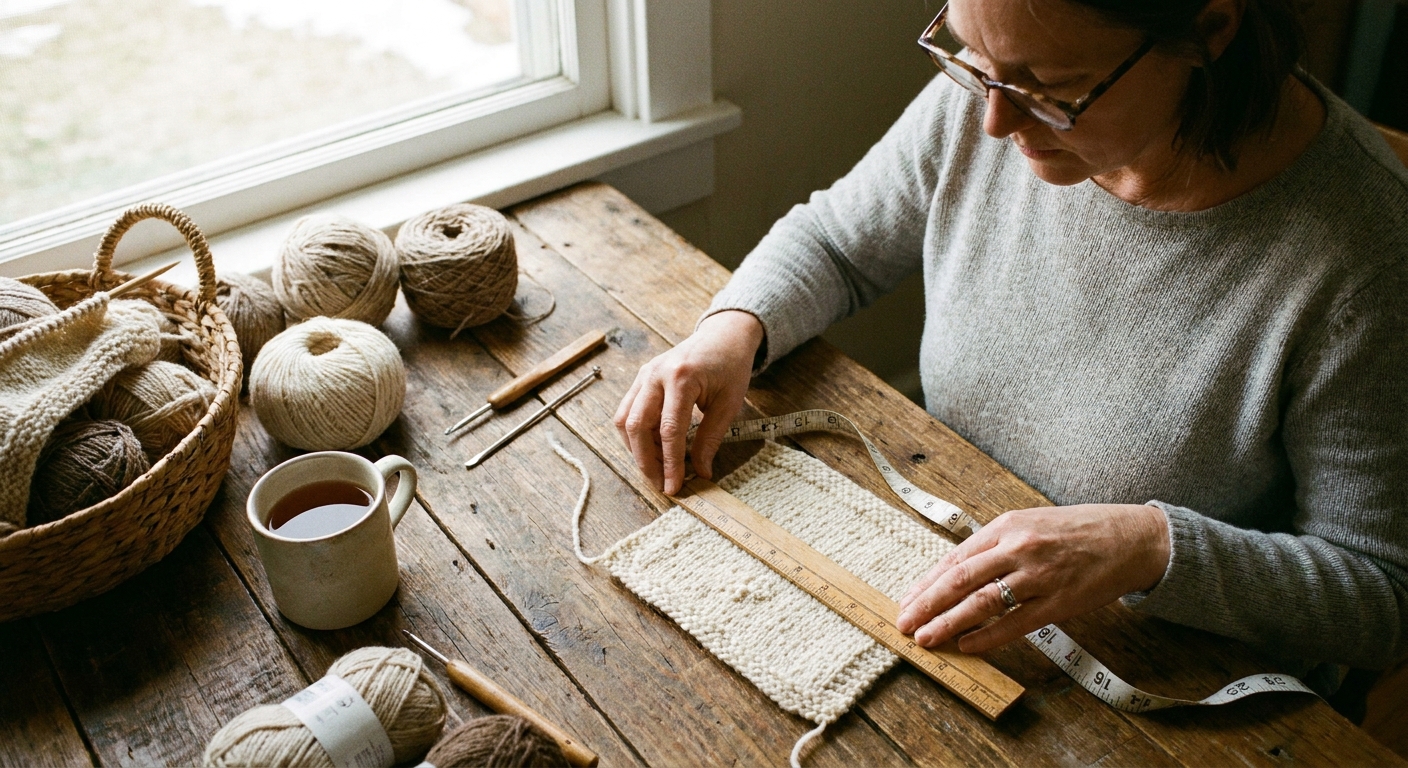
What substitution means
Substitution is not just “same yarn weight.” A successful swap keeps three things as close as possible to the original:
- Gauge and firmness (stitches and rows per measurement, plus how dense or drapey the fabric feels)
- Drape and elasticity (how the fabric hangs and how it springs back)
- Finished measurements (especially for fitted garments and anything with negative ease)
You can change one of these on purpose, but when it happens accidentally, that is when projects go sideways.
Step 1: Read like a detective
Before you look at replacement yarns, pull these details from the pattern notes:
- Recommended yarn name (and fiber content if listed)
- Yardage and grams per skein
- Total yardage required (and whether it is per size)
- Gauge and whether it is in stockinette, pattern stitch, or after blocking
- Needle size
- Construction clues: lace and cables need clarity, colorwork needs grip, socks need resilience, etc.
If you are rusty on gauge technique, my best advice is to slow down and treat the swatch like part of the project, not an optional speed bump. This walkthrough helps: How to Knit and Block a Gauge Swatch.
Step 2: Pick your method
There are three reliable ways to substitute yarn. I use them in this order, depending on what information I have.
Method A: Match by length per weight
Yarn labels are inconsistent across brands. One company’s DK can behave like another company’s sport. A more consistent comparison is length per mass, sometimes called grist:
Yards (or meters) per 100 g
This is often a more dependable starting point than weight category labels, but it is still a proxy. Yarn construction (woolen-spun vs worsted-spun, blown or chainette yarns, tight twist vs lofty twist) can change the feel and the real-world thickness even when the numbers match.
How to do it:
- Find the recommended yarn’s yards per 100 g.
- Find your candidate yarn’s yards per 100 g.
- The closer these numbers are, the closer the yarn thickness tends to be in real fabric.
Quick math: If a yarn is 220 yards per 100 g, and another is 200 yards per 100 g, they are usually close enough to audition with a swatch. If the difference is large (say 220 vs 140), expect a major gauge shift.
Method B: Match by gauge range
Some patterns and yarn companies share typical gauge ranges, like “18 to 20 sts = 4 inches.” If your substitute yarn commonly lands in that band at a similar needle size, it is a strong candidate.
I still check both stitch gauge and row gauge after washing and drying because two yarns can land on the same stitch count but behave very differently in drape and growth.
Method C: Match by yarn weight category
This is the “both are worsted” approach. It can work, especially for simple accessories, but it is the easiest way to end up with a fabric that feels wrong even if your stitch count technically matches.
Step 3: Fiber, drape, and bounce
Even with perfect stitch gauge, fiber choice changes the personality of the fabric. When I want a substitute that behaves like the original, I ask two questions: “How does it hang?” and “How does it bounce back?”
Wool
- Strengths: elastic, forgiving, blocks beautifully, great memory for ribbing and cuffs
- Watch for: some wools bloom after blocking, which can soften stitch definition
Superwash wool
- Strengths: easy care, smooth feel
- Watch for: can relax and grow in length after washing, especially in heavier garments
Cotton
- Strengths: crisp stitch definition, cool to wear
- Watch for: low elasticity, can feel heavy, tends to lengthen with wear
Alpaca
- Strengths: soft, warm, drapey
- Watch for: less bounce, can grow, cables may relax and lose depth
Acrylic
- Strengths: budget-friendly, easy care, consistent
- Watch for: blocking behaves differently than animal fibers, and it can feel warmer or less breathable for some people depending on fabric density
Blends
Blends are my go-to when I want to replicate behavior. Wool plus nylon for socks. Wool plus cotton for transitional garments. Wool plus alpaca when I want softness without total drape collapse.
If you want a deeper look at how wool and acrylic behave in garments, this guide is a helpful starting point: Wool vs Acrylic Yarn for Sweaters.
Step 4: Construction matters
Fiber is only half the story. Two yarns can share a fiber blend and a similar yards-per-100 g number and still knit up like completely different personalities because of construction.
Woolen-spun vs worsted-spun
- Woolen-spun tends to be loftier and airier. It can feel warmer and lighter, and it can fill space at a given gauge.
- Worsted-spun tends to be smoother and denser. It often gives crisp stitch definition and can feel a bit heavier and more structured.
Chainette and blown yarns
- These can be surprisingly light for their thickness because air is doing part of the work.
- They can also behave differently under gravity, which matters in longer garments.
Twist and ply
- Higher twist and multiple plies often mean better stitch definition and durability, but sometimes a firmer hand.
- Loftier, lower-twist yarns can be softer and more fluid, but can pill more and blur fine texture.
Step 5: Yardage math
Substitution mistakes often show up at the end, not the beginning. The fabric looks fine, the gauge is close, and then you run out of yarn because your substitute has different yardage per skein.
Estimate how much you need
Use the pattern’s total yardage as your baseline. Then calculate skeins for your substitute:
Skeins needed = (pattern total yards) ÷ (yards per skein of your substitute)
Round up. Always.
If the pattern lists only skeins
Sometimes patterns list “X skeins” of a specific yarn but not the full yardage. In that case:
- Multiply skeins by yards per skein of the recommended yarn to get total yardage.
- Then divide by yards per skein of your substitute.
Add a buffer
I add extra yarn when any of these are true:
- Highly textured stitches (cables, bobbles, heavy ribbing)
- Colorwork (floats quietly eat yardage)
- Long sleeves, hoods, big collars
- You are between sizes or lengthening the body
Step 6: Swatch with intent
When you are substituting, your swatch has two jobs:
- Hit stitch gauge so sizing math stays trustworthy
- Confirm fabric behavior so the finished piece feels right
My swatch routine
- Knit a swatch larger than 4 inches so edge distortion does not lie to you.
- Wash and dry it the way you will treat the finished item.
- Let it rest flat. Many yarns relax after drying.
- Measure stitch gauge and row gauge.
- Touch test: does it feel too stiff, too limp, too airy, too dense?
If you want the full step-by-step for washing and blocking swatches, head here: How to Knit and Block a Gauge Swatch.
One more variable: needles and hands
If you are thinking “But I always get gauge with this needle size,” I get it. Substitution can still shift things because:
- Needle material changes friction. Many knitters knit a touch tighter on grippy bamboo than on slick metal.
- Your knitting style matters. Some of us tighten up with splitty yarns or loosen up with soft, lofty yarns.
That is another reason I like a washed swatch. It captures your real gauge, not your hopeful gauge.
When row gauge matters
Row gauge matters most when:
- The pattern tells you to knit “for X inches” in multiple sections (sweaters, hats, sleeves)
- You have shaping that is written by rows, not inches
- You are working stitch patterns where vertical repeat alignment matters
If your stitch gauge matches but row gauge is off, you can usually compensate by knitting to measurements. If your stitch gauge is off, the size changes. That is the bigger problem.
A worked example
Here is what this looks like in real life.
- Pattern yarn: 220 yd per 100 g, wool, gauge 20 sts = 4 inches in stockinette after blocking.
- Stash yarn: 200 yd per 100 g, wool blend, similar care instructions.
Step 1: The grist is close (220 vs 200), so it is worth auditioning.
Step 2: I swatch in stockinette, then wash, dry, and rest it.
My results: On the recommended needle, I get 19.5 sts = 4 inches (slightly looser) and the fabric feels a bit drapier than the original yarn description suggests.
My fix: I go down one needle size and reswatch. If I land at 20 sts = 4 inches and like the fabric, I knit the pattern as written. If I hit gauge but the fabric feels too dense, I accept the drapier fabric and either knit a size down or choose a pattern where drape is a feature, not a bug.
Common swap scenarios
Wool to cotton
Expect less stretch, more weight, and potential length growth. I avoid this swap for anything that relies on ribbing to hug the body, unless the design is intentionally relaxed.
Acrylic to wool
Often, more wool content means more natural elasticity and better “memory,” which can be great for ribbing, hats, and structured sweaters. That said, some acrylics are surprisingly springy, and some wool blends (especially alpaca-heavy ones) are less bouncy. Let the swatch tell you the truth.
Smooth to fuzzy
Texture changes everything. Your stitches may look less crisp, and your gauge can appear different because the halo fills in gaps. If the pattern relies on sharp definition, fuzzy yarns tend to blur it.
Plied to singles
Singles can drape beautifully, but they can pill more and show abrasion in high-wear spots. I love them for shawls, cowls, and gentle-wear garments, and I am more cautious for elbows, underarms, socks, and mittens.
If gauge changes anyway
Sometimes you love the substitute yarn enough to accept a different gauge. That is allowed. You just need to make the math honest.
If stitch gauge is different
Use this to estimate finished width:
Finished width (inches) = stitch count ÷ stitches per inch
Example: if a body is 200 stitches around and you knit 5 sts per inch, that circumference is about 40 inches. If you knit 4.5 sts per inch, it becomes about 44.4 inches. That is a full size swing.
Three ways to fix it
- Change needle size until your stitch gauge matches the pattern.
- Knit a different size in the pattern based on your gauge math.
- Recalculate stitch counts for key measurements (best for experienced knitters or very simple shapes).
For socks and cuffs, where stretch is non-negotiable, I am especially picky about getting gauge right. If you knit a lot of socks, you might also like: Best Cast-On Methods for Stretchy Socks and Ribbed Cuffs.
Color and texture surprises
Variegated and speckled yarns
Color pooling can change dramatically with gauge and stitch pattern. If the pattern uses a solid yarn and you substitute a busy one, do a mini swatch in the stitch pattern to see if your fabric looks “confetti cute” or “visual chaos.”
If you love variegated yarn and want projects that flatter it, this is a fun one-skein option: One Skein Infinity Scarf for Variegated Yarn.
Stitch definition
In general:
- Smoother yarns show lace and cables more clearly.
- Hairy yarns soften edges and blur fine detail.
- High-twist yarns can make textured stitches pop, but may feel firmer.
My kitchen table checklist
- Confirm pattern gauge and whether it is blocked.
- Compare yards per 100 g between original and substitute.
- Compare fiber behavior: elasticity, drape, warmth, care.
- Consider construction: woolen vs worsted, chainette or blown, twist, ply.
- Calculate skeins needed from total yardage.
- Swatch, wash, dry, rest, measure.
- Decide: adjust needle, adjust size, or accept a different fabric on purpose.
If you like keeping project details tidy, you might enjoy my low-stress approach to tracking yarn, needles, and modifications. Even though it is framed for crochet, the same idea works for knitting substitutions too: Make a Project Card Before Starting Crochet.
FAQ
Can I substitute based on grams alone?
Not safely. Grams tell you weight, not thickness. Two 100 g skeins can have very different yardage, which changes both gauge behavior and how many skeins you need.
Is it okay if I match stitch gauge but not row gauge?
Usually, yes. Most patterns can tolerate row gauge differences if you knit to measurements for length. It becomes trickier with shaping written strictly by rows or stitch patterns that must line up vertically.
What is the fastest “good enough” swap for a beginner?
Choose a yarn with similar yards per 100 g and a similar fiber type, then make a washed swatch and adjust needle size if needed. If you are new to knitting and want an approachable foundation for yarn choices in general, this is a helpful read: 7 Best Yarns for Beginner Knitters.
Why does my fabric feel stiffer with a substitute even at the same gauge?
Fiber and construction. A high-twist, multi-ply yarn can feel firmer than a lofty woolen-spun yarn at the same gauge. Cotton and linen also tend to feel crisper than wool because they have less natural elasticity.
One last bit
If yarn substitution feels like juggling at first, you are not behind. You are learning the part of knitting that designers do behind the scenes. Give yourself permission to test, to wash the swatch, and to change your mind. The whole point is to end up with a fabric you love wearing, not to “follow the label weight” perfectly.