
Planning a Crocheted Christmas Tree Skirt

I love a Christmas tree skirt because it is one of those rare holiday makes that feels big and special, but it is also wonderfully practical. It hides the stand, catches the needles, and gives you a soft place to tuck gifts. The only downside is that tree skirts can quietly become yarn-eaters, especially once you scale past a simple 36 inch circle and start adding texture, colorwork, or a thick border.
This is the planning guide I wish I had the first time I decided to crochet a “generous” skirt and realized halfway through that I had planned like it was a table topper. We will talk about how to estimate yardage, how fiber blends change your numbers, and why washable acrylic-wool blends are my sweet spot for most households.
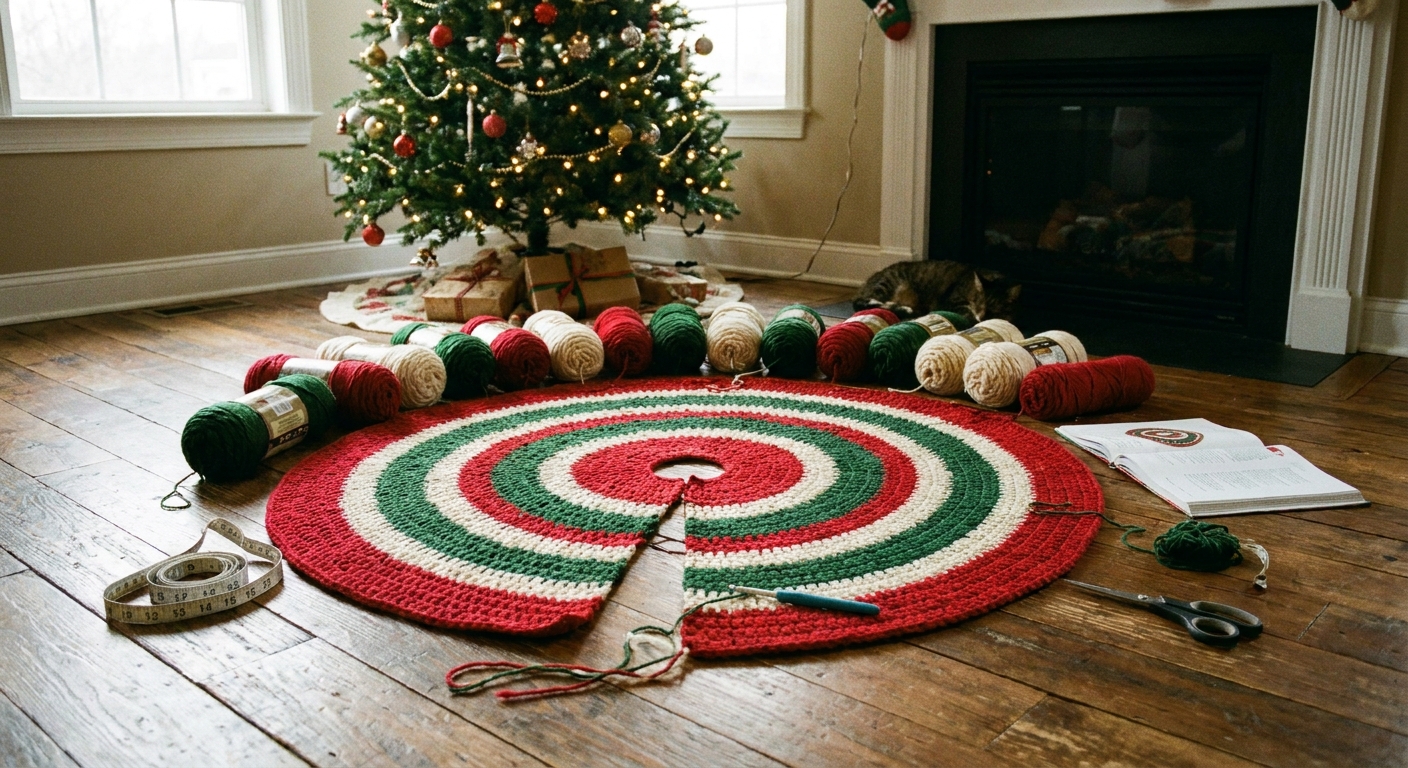
Start with size and shape
Before you think about yarn, decide what you are actually making. Tree skirts tend to be one of three shapes:
- Full circle with a center hole and opening: classic “round skirt” look.
- Hexagon or other polygon: grows like a granny style blanket, often easier to keep flat.
- Star or scalloped shapes: gorgeous, but the points add extra surface area and yardage.
Then measure your tree stand area. I do this with the stand set up, because “it looks small in the box” is a holiday lie we tell ourselves every year.
Three measurements to write down
- Finished diameter you want (common: 36 to 60 inches).
- Center opening diameter (the hole around the trunk and stand, often 3 to 6 inches depending on stand).
- Any depth you want past the widest part of the stand (I like at least 6 to 10 inches of skirt beyond the stand so gifts sit on crochet, not metal).
If you want a quick rule of thumb: a 36 to 42 inch skirt suits slimmer trees or tight spaces, while 48 to 60 inches reads “full, generous, gift-ready,” especially with a wider base tree.
The yardage math that works
There are two reliable ways to estimate yardage for a big, round project like a tree skirt:
- Swatch math (my favorite because it respects your personal tension).
- Pattern ratio math (helpful if you are resizing an existing skirt pattern).
Method 1: Swatch math
This method uses a weighed swatch to predict how much yarn your full skirt will eat. It is not glamorous, but it is accurate, especially when you are working with textured stitches that drink yarn. Also, swatch weights vary wildly by stitch choice and gauge. A denser fabric will produce a heavier swatch and a higher yardage estimate, and that is exactly why this method is so useful.
- Make a large, honest swatch in your actual stitch pattern. Aim for at least 8 x 8 inches. For highly textured stitches, go 10 x 10 if you can stand it.
- Block or steam it the way you will treat the skirt. If you are planning to wash it, wash the swatch. Acrylic-wool blends can relax after washing.
- Measure the swatch area in square inches.
- Weigh the swatch in grams using a kitchen scale.
- Use the yarn label to find yards per gram. If the label says 100 g = 220 yd, then 1 g = 2.2 yd.
- Compute yards per square inch: (swatch grams x yards per gram) divided by swatch area.
- Compute skirt area and multiply.
This gives you a baseline yardage for the main body. After that, you will add borders, ties, and a safety margin.
Skirt area for a round skirt with a center hole
Use the area of a ring:
Area = π × (R² − r²)
- R = outer radius (finished diameter divided by 2)
- r = inner radius (center opening diameter divided by 2)
Example with real numbers
Let’s say you want a 54 inch skirt with a 4 inch center opening.
- R = 27 inches
- r = 2 inches
- Area ≈ 3.1416 × (27² − 2²) = 3.1416 × (729 − 4) = 3.1416 × 725 ≈ 2278 square inches
Now imagine your swatch is 9 x 9 inches (81 sq in). You wash it, dry it flat, and it weighs 18 g. Your yarn label says 100 g = 219 yd (so 2.19 yd per gram).
- Swatch yardage ≈ 18 g × 2.19 = 39.4 yd
- Yards per sq in ≈ 39.4 ÷ 81 = 0.486 yd per sq in
- Total yardage ≈ 2278 × 0.486 = 1107 yd
That is your baseline for the main fabric, before borders, ties, and safety margin. If your stitch pattern is denser than this example, your swatch will likely weigh more and your final yardage will climb accordingly.
Method 2: Resizing a pattern
If you already have a pattern with a known yardage, you can scale yardage by comparing areas. This works best when you keep the same stitch pattern and yarn weight.
New yardage ≈ Old yardage × (New area ÷ Old area)
Because circles scale by radius squared, increasing diameter can jump your yardage fast. A 60 inch skirt is not “a little bigger” than a 48 inch skirt. It is much bigger in area.
Add a safety margin
For tree skirts, I recommend adding:
- 10 percent for simple stitches in a single color.
- 15 to 20 percent for textured stitches, stripes, or bobble-heavy borders.
- 25 percent if dye lots are unpredictable and you will be upset if you cannot match later.
If you have ever played “yarn chicken” with a holiday deadline, you already know why.
Metric conversion
If your yarn label lists meters, a quick conversion is 1 yard ≈ 0.914 meters. For a rough sanity check, you can treat 10 percent extra yardage as 10 percent extra meters too.
Quick yardage ranges
Every stitch pattern changes yardage, but these ranges help you sanity-check your plan for a worsted weight skirt (worked fairly solid, not lacy) in a washable blend or acrylic.
| Finished diameter | Typical yardage range | Notes |
|---|---|---|
| 36 in | 500 to 900 yd | Great “starter” size. Textured stitches push higher. |
| 42 in | 700 to 1200 yd | Often 4 to 6 skeins if your skeins are around 200 to 220 yd each. |
| 48 in | 900 to 1600 yd | Plan colorwork carefully. Borders can add a lot. |
| 54 in | 1100 to 2000 yd | Where stash-busting turns into intentional purchasing. |
| 60 in | 1400 to 2600 yd | Big statement piece. Strongly consider swatch math. |
If your stitch pattern is airy and open, you may land below these. If you are doing alpine stitch, bobbles, or thick front post texture, you can easily exceed them.
Why yardage jumps
When yardage surprises happen, it is usually because of one of these factors:
- Texture: post stitches, bobbles, puff stitches, and dense overlays can easily add 20 to 60 percent more yardage than a simple double crochet fabric. The fastest way to confirm for your stitch is to swatch both textures and compare weights.
- Thick borders: shells, ruffles, and wide picot edgings add length quickly because they are worked around the biggest round.
- Stripes and color changes: more ends, more tail length, and sometimes tighter tension in colorwork.
- Stiffness goals: if you want the skirt to lie perfectly flat and “behave,” you may choose tighter gauge, which uses more yarn.
My personal “yardage alarm bell” is any pattern that says “add a decorative border of your choice.” That is crochet-speak for: surprise math.
Fiber for a washable heirloom feel
Tree skirts live a very real life. They get stepped on, vacuumed, tugged when gifts slide, and stored in a bin for 11 months. So while 100 percent wool is dreamy, most families do better with a blend that can handle wear and still feel cozy.
If you want the deep dive on wool versus acrylic for long-lasting holiday makes, I also wrote about stockings here: Best Yarn for Heirloom Crochet Stockings: Wool vs Acrylic. Many of the same durability and care principles apply to a tree skirt.
Why acrylic-wool blends hit the sweet spot
- Washability: many blends tolerate gentle washing, but not all wool blends are machine-washable. Always check the label and test your swatch.
- Memory and bounce: the wool content helps stitches spring back and look less limp over time.
- Warm, “real” handfeel: even 10 to 30 percent wool can add that cozy, not-plasticky touch.
- Less pilling than bargain acrylic: not always, but often improved with a better twist and fiber mix.
Blend percentages I reach for
- 10 to 25 percent wool: easy-care, durable, and usually soft enough for sensitive hands.
- 25 to 40 percent wool: warmer and bouncier, but test wash your swatch and watch for shrink or halo.
- 50 percent wool or more: can be beautiful, but make sure you truly want the care routine and the cost for a floor-level holiday item.
What to check on the yarn label
- Care symbols: “machine wash gentle” is very different from “hand wash only.” If the skirt is for a home with kids or pets, be honest about your future self.
- Put-up consistency: for a large skirt, I prefer yarn lines that have stable yardage and color from skein to skein.
- Texture and twist: a tighter twist typically pills less, but can show stitch definition differently. Choose based on whether you want crisp cables or soft, blended texture.
Allergy and sensitivity note
Even a small wool percentage can bother some people. If anyone in the house is sensitive, consider an all-acrylic yarn that is labeled soft and washable, then plan a slightly firmer fabric (a touch smaller hook) so the skirt does not stretch out.
How fiber changes your estimate
This is the part that surprises newer crocheters: “same weight category” does not guarantee “same yardage used.” Fiber content affects drape, stretch, and how you naturally hold tension, which changes how much yarn ends up in the fabric.
In general
- More elastic fibers (wool, wool blends) can encourage a slightly tighter fabric if you crochet snugly, which can increase yardage.
- Slicker fibers can lead to looser tension and more drape, sometimes reducing yardage, but also risking a skirt that waves or grows.
- Loft and coverage: loftier yarns can make a fabric feel thicker at a given gauge, but yardage totals can go either way. Always check yards-per-gram and your swatch gauge rather than assuming loft automatically saves yarn.
My planning trick
When I am committing to a big holiday piece, I do two estimates:
- Swatch math estimate (from earlier).
- Reality check estimate by comparing to a similar project I have made in the same yarn category, like a round baby blanket or large doily-style throw.
If those two numbers are far apart, I trust the swatch and add a little more cushion.
Skeins without dye lot stress
Once you have a yardage target, converting to skeins is simple math, but buying strategy matters.
Convert yardage to skeins
Skeins needed = Total yardage needed ÷ Yardage per skein
Then round up, and include your safety margin first.
If you are using multiple colors
- Assign percentages to each color (example: 70 percent main, 20 percent contrast, 10 percent accent).
- Overbuy the main color. It is the hardest to match later and the most obvious if it shifts.
- Keep your ball bands until after the holidays. If you need to hunt for a match, you will want every code you can get.
If you are stash-busting, I strongly recommend making a tiny “color map” before you start. I use the same approach I share in Make a Project Card Before Starting Crochet, just adapted for holiday makes: planned colors, yardage estimates, and a note on what gets used where.
Stitches that behave
Tree skirts need to do three things: lie flat, resist stretching, and look good after being sat on by a cat who believes it is their personal throne.
Stitches that stay flatter
- Double crochet with regular increase rhythm: classic for round skirts.
- Granny-style clusters on a stable increase plan: forgiving and great for using multiple colors.
- Front post and back post texture used sparingly: adds structure without making the whole skirt heavy.
Stitches to swatch carefully
- Heavily textured repeats (bobble fields, puff stitch): gorgeous but can ripple if your increase spacing is not balanced.
- Very open lace: can stretch under gift weight, and the tree stand may peek through.
Flatness tip I use constantly
If your skirt starts to ruffle, you can often fix it by:
- Going down a hook size for a few rounds, or
- Reducing the increase frequency slightly for one round set.
If it starts to cup, do the opposite: add a few increases or loosen your tension. This is why I love trying the skirt under the tree stand early, even when it looks comically small. It tells you whether your fabric wants to behave.
Choices that change yardage
Two tree skirts can be the same diameter and still use very different amounts of yarn. These construction details are the usual culprits:
- Joined rounds versus continuous rounds: joined rounds can add a little extra yarn in turning chains and joins, especially if you are also “fixing” the seam with extra steps.
- Surface crochet: outlines, faux cables, and surface slip stitch details are beautiful, and they add yardage in a sneaky, hard-to-estimate way unless you swatch them too.
- Appliqués and motifs: snowflakes, holly leaves, stars, and layered petals add dimension, but each motif is its own little yardage project.
- Extra backing rounds: adding a thick stabilizing band around the center opening or along the slit can be worth it for durability, but it is not “free” yardage-wise.
Finishing details to budget
Do not forget to budget yarn for the parts that are not the big circle.
- Opening edge and ties: if you are adding a button band, i-cord ties, or thick braided ties, set aside 30 to 100 yards depending on bulk.
- Sturdy edging: a round of single crochet plus a crab stitch can add structure with moderate yardage. A ruffled shell border can add a lot more.
- Lining: lining does not change yarn yardage, but it can help your crochet slide less on hardwood floors. If you line, consider how washable the whole unit will be.
Care for blend skirts
Always follow the label first, but here is the routine that keeps most blend skirts looking fresh:
- Shake out debris outdoors before washing.
- Spot clean sap, spills, or pet mess quickly with cool water and mild soap.
- Wash gently (hand wash, or gentle machine cycle only if the yarn label allows it).
- Dry flat to keep the circle true. I reshape the points or scallops with my hands while it is damp.
If you are making snowflake motifs or stiffened details for the skirt, you might like my thoughts on starching and crisp finishes in Crisp Crochet Snowflake Ornaments: Thread Size and Starching. The same “test first, then commit” mindset helps a lot on holiday pieces.
Common questions
Should I buy all the yarn at once?
If you care about dye lots, yes. For large skirts, I buy everything for the main color at once, plus the safety margin. Accent colors are a bit more forgiving.
Can I hold two strands together?
You can, but treat it like a new yarn: swatch, wash, measure. Holding double changes drape and often increases yardage because the fabric gets thicker and denser.
What if my skirt is not a perfect circle?
If it is a star or scalloped shape, yardage will usually be higher than the same diameter circle because of the extra area in the points. Swatch math still works, you just estimate the final area a bit more generously and add a larger safety margin.
What yarn weight is easiest?
Worsted is the friendliest for most crocheters: fast progress, easy stitch definition, and plenty of blend options. Bulky can be quick but heavy. DK can be beautiful but takes longer and can require more total yardage than you expect.
Planning checklist
- Decide finished diameter and center opening.
- Choose stitch pattern, then swatch in the real yarn.
- Wash and dry the swatch the way you will treat the skirt.
- Estimate yardage (swatch math), then add a safety margin.
- Convert yardage to skeins and buy with dye lots in mind.
- Plan borders, ties, and color placement before you crochet the last big rounds.
If you want more holiday project ideas once your skirt plan is set, visit Guide: Holiday Crafts. I keep all my seasonal favorites gathered there so you can hop between projects without digging through your bookmarks.