
Textured Cotton Waffle Stitch Dishcloth

There are a handful of crochet projects I come back to when I want that comforting, instant payoff feeling. A cotton dishcloth is one of them. It is useful, it is forgiving, and it is the perfect place to enjoy texture without committing to a whole blanket. This waffle stitch version is my go-to when I want a cloth that actually scrubs and soaks up water, not one that just looks pretty on the counter.
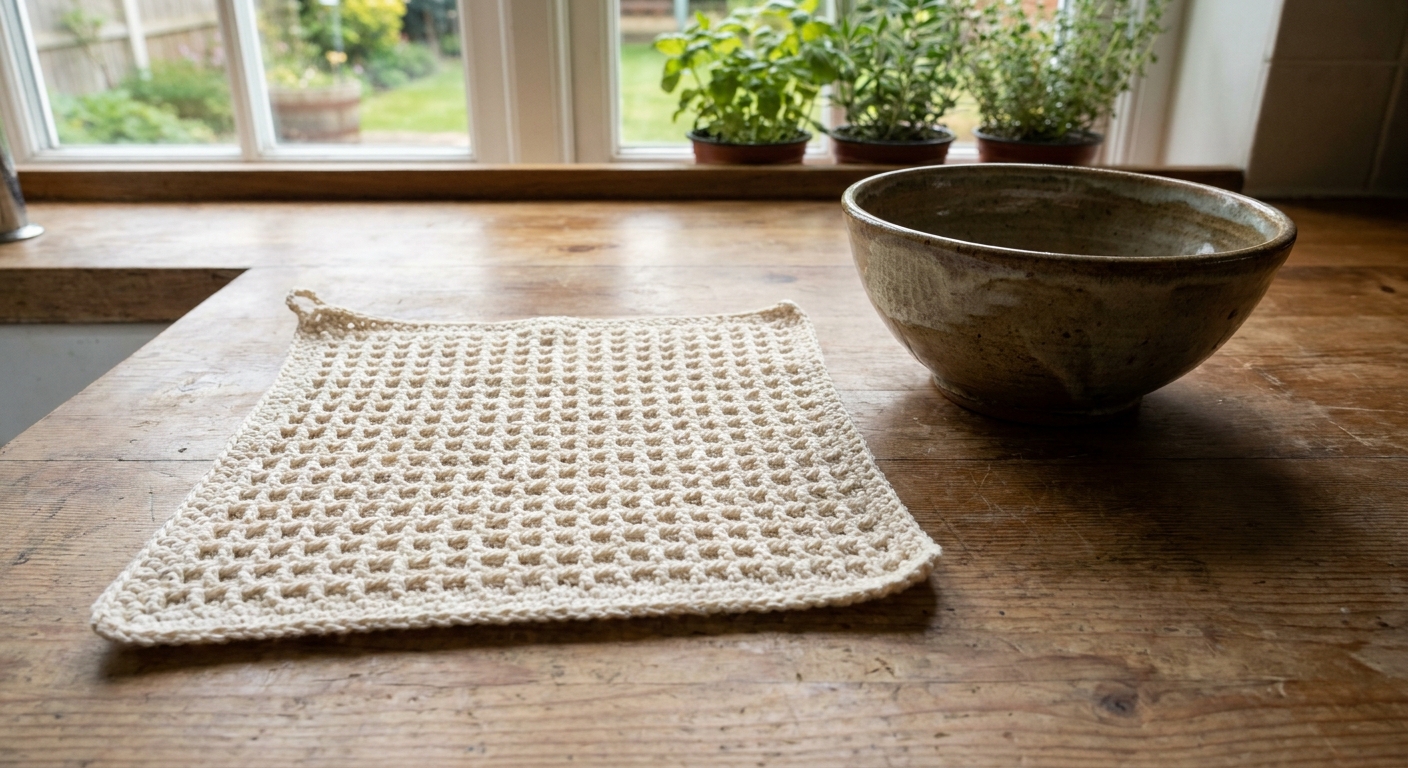
Why waffle stitch works
Waffle stitch has little pockets and ridges that act like gentle scrubbers. In cotton, those ridges soften with washing but keep their structure, so the fabric stays grippy and absorbent.
- Textured but not bulky: It feels substantial in your hand without taking forever to dry.
- Absorbent: The raised squares hold a surprising amount of water.
- Durable: With a tight-ish cotton yarn, this stitch holds up to repeated washing.
- Eco-friendly swap: One cloth can replace a lot of paper towels over its lifetime.
Best cotton yarn
Not all cotton behaves the same, especially once it is wet. For dishcloths, I prioritize cotton that is sturdy, smooth enough to glide through the stitch, and washable without stretching into a sad rectangle.
My yarn checklist
- Fiber: 100% cotton is my default for dishcloths because it is absorbent and can handle frequent washing. Cotton blends can be fine, but some blends reduce absorbency.
- Construction: Plied cotton tends to resist splitting and holds stitch definition. Very softly spun cotton can fuzz and pill faster.
- Weight: Worsted weight (category 4) is the classic dishcloth choice. It gives a dense fabric without feeling like a potholder.
- Finish: Mercerized cotton is smoother and often a bit shinier. It can feel slightly less grabby than unmercerized cotton, but it wears well and looks crisp.
What to avoid
- Stretchy yarns: Dishcloths get tugged. A lot.
- Fuzzy novelty cottons: They can trap lint and take longer to dry.
- Very loosely spun cotton: It can grow and lose its shape after a few washes.
If you want more general yarn know-how for matching fiber to function, my broader yarn notes live in Guide to Yarn Crafts.
Dishcloth pattern
This pattern is written for a square cloth with a tidy single crochet border. It is easy to resize, and I will show you how.
Skill level
Adventurous beginner. You need to be comfortable with chain, single crochet, double crochet, and working in rows. You will also be doing front post double crochet to form the waffle pockets.
Finished size
About 8.5 in to 9.5 in square, depending on your yarn, hook, and tension.
Materials
- Worsted weight 100% cotton yarn, about 55 to 70 g (one standard ball is plenty)
- 5.0 mm (H/8) crochet hook, or size to get a fabric you like
- Scissors
- Tapestry needle
Gauge
Gauge is not critical for a dishcloth, but you want a fabric that is not lacy. If your squares look airy, go down a hook size. If your hands feel tense, go up a hook size.
Abbreviations (US terms)
- ch: chain
- sc: single crochet
- dc: double crochet
- st(s): stitch(es)
- rep: repeat
- fpdc: front post double crochet
Notes before you start
- The waffle texture is made by alternating dc stitches worked normally with fpdc stitches worked around the post of the stitch below. Those fpdc stitches pull the fabric forward and create the grid.
- Quick fpdc refresher: Yarn over, insert your hook from front to back to front around the post of the next stitch, yarn over and pull up a loop, yarn over and pull through two loops twice.
- The first and last stitch of every waffle row are worked as regular dc for a cleaner edge.
- The ch-2 at the start of waffle rows does not count as a stitch. You will make your first dc in the first stitch of the row.
- The ch-1 at the start of sc rows does not count as a stitch. Work your first sc in the first stitch.
- Waffle stitch has a natural push and pull. Counting stitches for the first few rows helps the edges stay tidy.
- If you like staying organized (especially if you plan to make a set), I strongly recommend using a simple project note card. I wrote about my method here: Make a Project Card Before Starting Crochet.
Stitch multiple
This waffle pattern works best over a stitch count that is a multiple of 3.
Pattern
Foundation
Ch 31.
(You will work into 30 chains, which gives you 30 stitches after Row 1. 30 is a multiple of 3.)
Row 1 (setup)
Sc in 2nd ch from hook and in each ch across. (30 sc)
Ch 1, turn.
Row 2 (setup)
Sc in each st across. (30 sc)
Ch 1, turn.
Row 3 (waffle row A)
Ch 2 (does not count as a st). Dc in first st. *Fpdc around next st, dc in next 2 sts.* Rep from * to * across to last 2 sts. Fpdc around next st, dc in last st. (30 sts)
Ch 1, turn.
Row 4 (waffle row B)
Ch 2 (does not count as a st). Dc in first st. *Dc in next st, fpdc around next 2 sts.* Rep from * to * across to last 2 sts. Dc in last 2 sts. (30 sts)
Ch 1, turn.
Rows 5 to 18
Repeat Rows 3 and 4 a total of 8 times (Rows 3 and 4, plus seven more repeats). You will end on Row 18. After Row 18, do not fasten off.
Row 19 (top edge)
Ch 1, turn. Sc in each st across. (30 sc)
Ch 1, turn.
Row 20 (top edge)
Sc in each st across. (30 sc)
Border
Without fastening off, work sc evenly around the entire dishcloth, placing 3 sc in each corner to keep it flat. Join to the first sc with a slip stitch, fasten off, and weave in ends.
Border tip: Along the top and bottom, you can place 30 sc (one per stitch). On the sides, aim for about 1 sc per row end, which is usually about 20 sc per side here. Because waffle rows are chunky, you might find it looks neater to work 2 sc around a row end every other row. If the edge starts to ruffle, skip a spot occasionally. If it starts to cup, add an extra sc here and there.
Resize it
I love a standard 9 inch cloth, but some kitchens call for a smaller quick wipe square and some folks prefer a slightly larger washcloth size.
- To change width: Start with a chain that gives you a stitch count that is a multiple of 3 after Row 1. An easy way to do that is: choose your desired stitch count (multiple of 3), then chain that number + 1. Example: for 36 stitches, ch 37 (then sc in 2nd ch from hook gives you 36 sc).
- To change height: Work more or fewer repeats of Rows 3 and 4, then finish with the two sc rows and the border.
Care tips
Cotton dishcloths get better after a wash or two. The stitch relaxes and the cloth starts to feel like it belongs in your hand.
- Wash: Warm water is usually safe. Use hot water only if your yarn label allows it (especially with darker or highly saturated colors that may bleed at first).
- Dry: Tumble dry low or lay flat. Tumble drying can shrink cotton a touch at first, which often makes the texture even puffier.
- Skip fabric softener: It can reduce absorbency over time.
- Retire gracefully: When a dishcloth is too stained for counters, I demote it to grimy jobs like wiping patio furniture.
Troubleshooting
Pockets do not pop
Usually this is one of three things: the fabric is too loose, the front post stitches are being worked in the wrong place, or the yarn is too drapey.
- Try a smaller hook.
- Make sure you are working the fpdc around the post of the stitch below, not into the top V.
- Choose a firm, plied cotton.
Edges are wavy
Waffle stitch has natural push and pull. A simple sc border fixes most edge wobble, but it also helps to count stitches for the first few rows until your hands settle into the rhythm.
Cloth feels too stiff
Go up a hook size or pick a slightly softer cotton. Also remember that new cotton can feel board-like straight off the ball. Washing helps a lot.
More small projects
Dishcloths are my favorite one skein weekend win, but if you are in a practical-makes mood, you might also enjoy my reusable gift wrap ideas. They are the same kind of quick project that turns into a habit.